
2016 nostalgia and the lessons of history.
First post of 2026, so I figured I’d jump on the 2016 trend that is going around the Internet, and well, it’s a long one. In May 2016 my partner and I took the super important step in every relationship – our first holiday abroad together, the ultimate test of compatibility and grit. Since he is an archaeologist, he chose history as the main theme and I chose Pompeii as our destination, which worked out really well. We were still students on a tight budget, so we flew to Naples with the cheapest flight we could find and tried to sustain ourselves on one good meal per day, cheap snacks and limited drinks (no Aperol Spritz back then).
2016 vs 2026: on the outside
It is interesting to look back through my 2016 photos now, because the phone photo quality has evolved so much in just a few short years, so maybe we can already call the bad ones vintage? We all still travelled with paper maps instead of Google Maps because phone data was still relatively expensive abroad, Wi-fi wasn’t readily available at every corner and AI was the stuff of sci-fi. I’d never heard of matcha latte back then and having a capuccino with normal milk in the morning didn’t trigger my lactose intolerance which I seem to have suddenly developed upon turning 30. Despite being in probably the best shape of my life, I nonetheless remember struggling with the thought that I still wasn’t skinny enough. Growing up in the early 2000s era of heroin chic really damaged our perception of our bodies and I can see that same mentality slowly creeping back in with skinnytok trends in 2026. I think we should do our best not to let it, because skinny is not fit – I could stand to lose a few kilos right now, but I am physically stronger than I was back then and I am pretty sure I am healthier too.
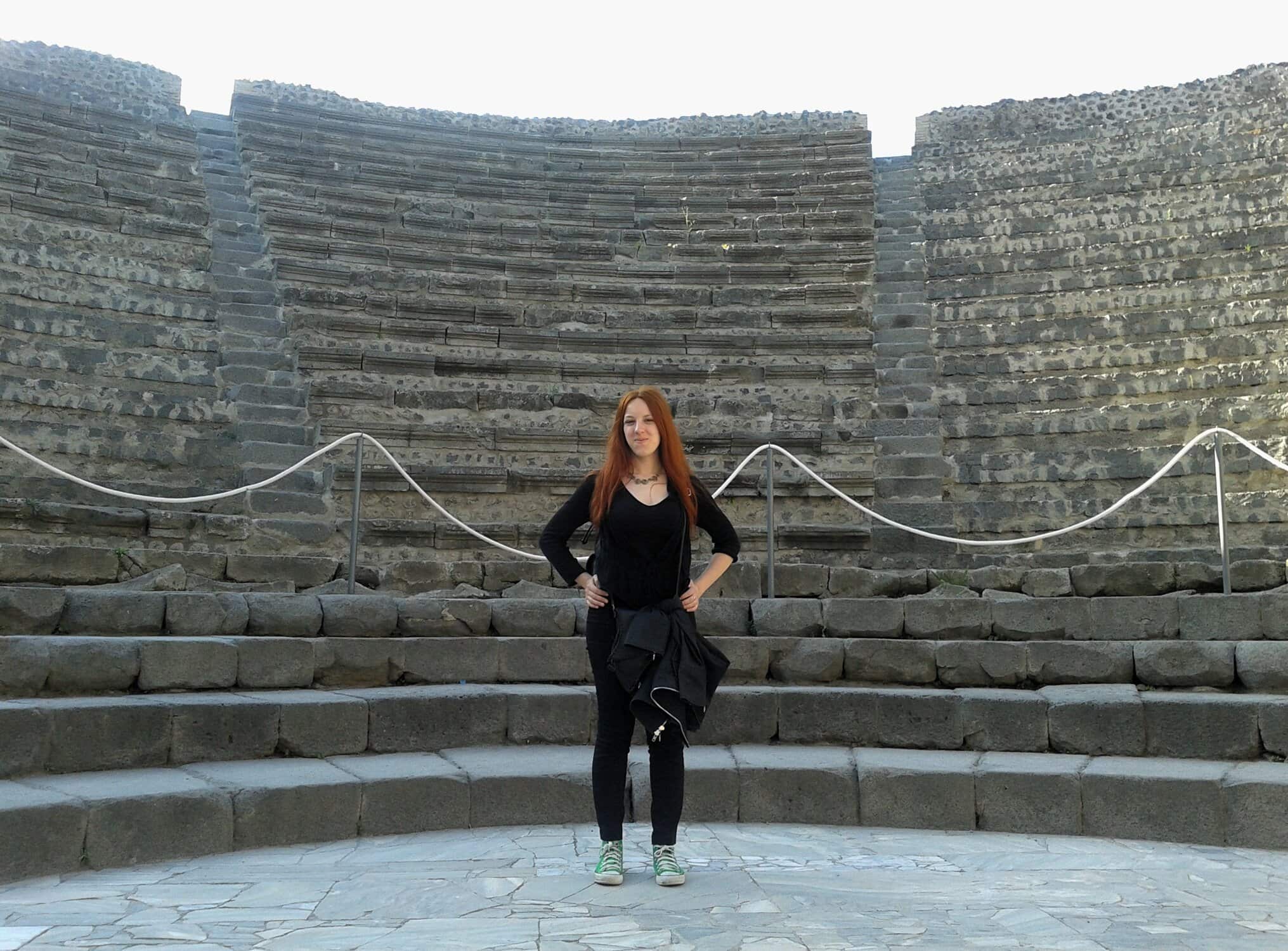
My partner and I are still doing really well, if anything we have gotten happier and mellowed down a bit over the years, although we still passionately bicker about the same issues. He can now almost grow a reasonable goatee and my hair is less vibrant red and more reddish-brown, but otherwise I think we still look more or less the same, even though the two strangers in the mirror have some grey hair, wrinkles and a ton of new responsibilities and probably look ancient to the kids we meet on the bus. My green All stars shoes on the cover photo are still holding on in 2026, I even recently passed them on to my sister-in-law because my feet got wider during corona times for some reason. I also still have the same jeans jacket and I still grieve that perfect scarf from London in these photos that I lost hiking in New Zealand a year later.
2016 was a simpler time, but nothing is ever simple in southern Italy. Although I am normally a fan of their chaotic vibe and food, I did not like Naples very much, so we did not spend a lot of time going around the city. The home of the true pizza napoletana is a huge, fast-paced and rather dirty metropola where there always seem to be too many people crowded into too narrow streets. Even though there are some impressive historical buildings and palaces in the city centre, I would say that the only thing I was really impressed by was the Naples underground, a complex system of cisterns and tunnels, ranging from Roman aquaducts to church crypts and catacombs and World War shelter. There are different tours you can take throughout the city and I think the ones we visited were the Catacombs of San Gennaro. Also, the little street shrines you can see everywhere are worth keeping an eye out for.
Impressions of Naples


However, the real reason for our trip was Pompeii and it did not disappoint. In its time, Pompeii was a thriving resort and trading city by the sea, with likely about 20,000 residents, and it is therefore a huge site spanning over 22 hectares with a third of it still buried under volcanic ash and undergoing excavations, so you need to plan for a full day visit if you want to explore anything. You can either visit just the city itself or also the suburban villas and the museum. The tickets are sold in timeslots, so I really recommend you check online and plan according to your interests as there are several recommended paths ranging from 2 – 7 hours walk.
Pompeii was founded in the 6th or 7th century BC and later colonised by the Romans, until its existence was rudely interrupted by the volcanic eruption of the nearby Vesuvius in 79 AD. It is estimated that about 10% of the city population died during the eruption, likely from thermal shock and toxic gases, and the city was left buried under several meters of volcanic ash. There is archaeological evidence that some of the residents who managed to flee later returned and attempted to reoccupy the territory, but it wasn’t until the 16th century when large-scale excavations began under the direction of a Spanish military engineer that the city started to emerge perfectly preserved from under the ash. It is now one of the most famous UNESCO world heritage sites and the excavations and restoration efforts are constantly ongoing, so you will likely see active works on site.
I promise you that visiting Pompeii is rather fun for an archeological site, and as close as you can get to experiencing life in Ancient Rome. Most of the statues and artefacts on display throughout Pompeii are replicas, with originals kept in the museums. Since even people and animals were forever petrified in ash on the spot where they passed away, archaeologists later made casts to study and preserve them and there are parts of the city that truly feel frozen in time, some of them tragic like the Garden of Fugitives with its 13 bodies and some of them very much alive, like the House of the Faun. The insides of the buildings are remarkably well-preserved, with colourful wall paintings, intricate mosaics, all sorts of decorative elements, niches and various storage objects. You can stroll through the Forum, the central marketplace, visit the amphitheatre, stop in several temples, explore regular and luxury houses, the baths and of course, the infamous brothel with some seriously naughty art.
One of the impressions that stuck with me was how modern the city seemed despite being over 2000 years old – the bricks, the cobbled roads, the vibrant pigments, sophisticated drainage and water delivery systems, public baths, street names, traffic organisation and even graffiti. Pompeii is a study in Roman urbanistic planning with a super structured 90° grid plan with designated zones and they even had sidewalks and raised stones for pedestrians crossing the streets. You can see my partner standing on some crossing stones in one of the photos below and this was one of my favourite details.
If you are like me, you will want to look inside every ruined house, see all the pictures and read all the inscriptions (it’s a good thing archaeologists are forced to learn Latin during their university years, so my partner could transalte them for me). The bad news is, you can’t – or rather it would require more than 1 day, so it is really worth planning your route in advance. Try to pace yourself and bring snacks, as there is only one cafeteria inside the ruins near the Forum.
IMpressions of POmpeii


Naturally we also had to visit the great culprit – Vesuvius. Vesuvius or Vesuvio is a stratovolcano, which was formed due to the collision between Eurasian and African tectonic plates. It is one of Europe’s most active volcanos with over confirmed 50 eruptions since the Pompeii event and also one of the most dangerous ones, as several million people would be affected if it were to erupt again. Although Vesuvius is still classified as an active volcano, its last eruption was in 1944 and it hasn’t produced more than some excess hot gases since. However, it is still exciting to walk around its crater and witness the smoke curling out of its maw as if it wants to remind us all that it should not be disregarded.
Vesuvius was once worshipped as a sort of natural deity and can be found depicted in the surviving Pompeii wall paintings as a vine-covered mountain known for fertility and protection. It is believed that the residents of Pompeii did not recognise the danger of Vesuvius as an active volcano, as it had not erupted in living memory and its slopes were cultivated for agriculture. Today it is part of a national park with many nature trails, although most people only visit the peak of Mount Vesuvio with its Gran Cono (the grand cone) crater like we did. The Gran Cono formed during the eruption that destroyed Pompeii and some of the other Roman towns, when the previous, much higher structure known as Mount Somma collapsed due to the force of the blast. There are several bus options from Pompeii or the nearby towns to the parking lot where trail no. 5 starts and it is a short, relatively easy 20 minute hike up to the crater. The tickets can only be bought online and I recommend going early as you don’t want the trail to be crowded.
The crater of Vesuvius


While you are in Pompeii, you should also check out the lesser known volcano-stricken town, Herculaneum, which is located in nearby Ercolano and also easily reached by public transport. Tickets can be bought on site (16€ per person as of 2026) and it should take you about 2 hours to see everything. According to myth, Herculaneum was founded by Herculus upon his return from Iberia and later conquered by the Romans. At its peak, it had about 4000 inhabitants before it was hit by an earthquake in 62 AD and then buried by Vesuvius in 79 AD, waiting to be rediscovered in the 18th century.
Much like Matera, Herculaneum and Pompeii were sites of national disgrace for a while, as they were referred to as “the only archaeological sites in the Western world in advanced state of deterioration without a civil war to justify it” and faced mismanagement and vandalism until organised restoration efforts with government and EU budgets of 100+ millions were kicked-off in the early 2000s, culminating in projects such as the Great Pompeii Project in 2012/2013, which helped restore about 10,000 at-risk buildings.
Although Pompeii is the larger and more famous site, Herculaneum also hides a lot of interesting details and beautiful wall paintings. It is situated right in the middle of Ercolano in a square enclosure, so the feeling of visiting living history is even stronger. Unlike Pompeii, which is a distinct mass tourism site and its own park, descending down to Herculaneum ruins from the busy streets of Ercolano feels like walking back in time, as if you just passed into another area of the city and can expect to run into residents from Ancient Rome going about their day. Only about a fifth of the town is visible in open excavations, mainly the residential and commercial districts, while some parts of the public part of town, such as the theatre, the baths and the gymnasium, can be visited through underground tunnels.

The whole town was buried under about 15 meters of ash and tufaceous material, which made excavations exceptionally difficult. However, the deep layer also helped preserve not only the buildings, but also organic material such as wooden furniture, clothes, food and even a whole collection of more than 1000 ancient Greek papyri found in the nearby Vila dei Papyri, which was only fully excavated in the early 2000s. Herculaneum therefore offers a rare complete glimpse into the daily life of the Romans, although you won’t be able to see it all in one place, as the findings are scattered in museums around the world. We visited the National archeology museum of Naples, which holds a lot of artefacts from Pompeii and Herculaneum and is definitely worth a visit if you want to see the originals and the small details.
Impressions of herculaneum


2016 vs 2026: on the inside
The 2016 trend is related to the Dead Internet Theory, i.e. that 2016 was the year when AI generated content started to dominate the Internet and search results, beginning with the rise of political bots on social media and the now overflowing AI-generated art. When I am visiting historical sites like Pompeii and Herculaneum, it always amazes me how little the basic principles of man-made objects, structures and engineering mechanics have changed over the millennia, as a lot of them are still fundamentally the same even after 2000 years. What strikes me as the most significant change, however, is often our relationship towards art and aesthetics.
Classical art was something that was a life-long practise, reverently perfected and valued to the point where it had an intangible, almost philosophical value. It constituted basic education in schools, often superseding functional skills. Even during the Middle Ages when a lot of scientific and cultural progress in the West was suppressed, art and embellishment survived for the glory of God, albeit in a different form. Then with the rise of the printing press and the Industrial era, decoration became a commodity produced by machines and art became a collector’s luxury, until we finally ended up with modern art, which is often just a provocation for its own sake, designer minimalism, which often lacks soul, and art history instead of creative exploration as the basis of our art classes in school. Same goes for music, which no longer requires one to carry a tune or master an instrument in 2026, and fashion, where utilitarian, comfy sports clothes are now acceptable in situations that would not work in 2016.
The above are my extrapolations and opinions, so of course opinions differ – art, music and fashion should adapt to the zeitgeist and make us question our perceptions, so forgive me my amateur art historian moment, but I do believe that our modern society has forgotten the value and purpose of creative works and self-expression that don’t serve a marketing function. That was apparent already in 2016 and it is even more pressing now in 2026 with the AI-generated art and music everywhere. Craftsmanship is increasingly rare, difficult to obtain due to our lack of focus and also because it no longer guarantees a liveable wage despite the significant personal investment required to attain it, and creativity has been relegated to a secondary hobby reserved for kids and dreamers, even though it is just as essential.
Not only do we no longer place the same monetary value on quality creative works, but we are relying on digital tools to the point of losing the underlying creation and processing skills. We rarely doodle, draw or paint (leading to a lack of visual judgement in new generations of students across design and engineering fields, which opens a lot of questions regarding the future direction of design education); we are reading full texts less and less (I believe we are all familiar with the declining books and reading comprehension statistics); we are always multi-tasking while we listen to information; and now with the rise of AI (which I am actually really excited about and believe is a very useful tool that will change how we learn and do things, if we can only use it responsibly), we will likely write meaningful texts less and less as well, because we are so focused on optimising everything.
Unfortunately, creativity thrives in unoptimised space
There are studies that show we remember things better when we write them down on paper as opposed to typing them into a virtual document. And it’s not just about memory retention – handwriting and physical interactions with objects actively engage the full spectrum of our motor, sensory and cognitive processes, helping us develop and shape that vague spark of an idea into something concrete, which is why prototyping and drafting are such an improtant part of everything, from writing a blog post to engineering a product. One of the lessons I’ve learned from working in the automotive industry in the past year is that the Chinese automakers are overtaking the Western incumbents by building more prototypes and failing fast: fleshing out and discarding more ideas faster, which means they also learn and optimize faster. Granted, a lot of that is done with virtual tools and even with the help of AI, but they still need to process the idea from beginning to end to evaluate it, and that is where creativity and innovation happen. That is also where I see the greatest potential for our use of AI – to help us expand our ideas faster and cross-check them across multiple domains, which can help us work and learn faster, as long as we don’t trust the output blindly and let it entirely replace our process. Here’s an interesting article about how AI might change the way we think and I don’t see it as negative, just as evolution.
However, creativity is a skill just like any other, so we do need to practise it, whether that is at work while solving problems or as a type of hobby in our private lives. I was using art, music and fashion as a proxy to illustrate a point earlier, because they are the most common outward expressions of creativity we tend to take for granted or non-essential, but we tend to forget that creativity is also the limiting factor for our imagination, which is the basis of science and new discoveries. I firmly believe that at our core we are driven to create and that we are not meant to be idle without a purpose – whether that purpose is reaching the stars or baking the perfect loaf of bread, that is entirely up to you and not for me to judge. Which is why the experts also think it is essential for our brains and stress management to regularly be creative in a free, unbound way in whichever form suits us, even more so if you don’t have the opportunity to be creative at work. For me the creative outlets are writing and dancing, with occasional LARPs and attempts at drawing and embroidery thrown in. The point is not to be great or even good at everything you do as a hobby, the point is in the process and we should really think of it as an exercise for the brain. With increasing awareness of mental health and self-regulation, I hope that creativity will soon find its way on our basic self-care list, much like healthy eating, exercise and not bottling our feelings have, which was a major bonus point for 2026 until skinnytok started.
We are what we consume, on every level
Studies also show that to stimulate our imagination and therefore creativity, it is equally important to exist in beautiful spaces and consume quality creative works, which at the moment are still man-made and I doubt that AI will be capable of replicating the human spark quite soon. However, the entertainment we used to turn to during our time off in 2016 was art, theatre, books, music, movies, TV series, podcasts i.e. long-form content that made us think, feel and learn, which is now in 2026 increasingly replaced with short videos and extracts taken out of context that are literally poisoning our brain and rewiring our dopamine system. I can’t help but think that one of the most important lessons of history is that the impending collapse of a civilization is always very obvious in hindsight.
Therefore I wonder which path we will take in the West – will we get irrevocably hit by climate change like the residents of Pompeii that refused to evacuate in time, or will we surrender to decadence like Ancient Rome and become mentally over-fed, over-stimulated on rapid-fire content and increasingly rabid and irritable until a different society wipes us off the map? Perhaps both? While that may sound overly pessimistic, that is not my intention. I believe authenticity and creativity are the right means of resistance to prevent the Dead Internet Theory from becoming the Dead Society Theory where we would surrender our process and judgement to our AI tools and become entirely disconnected from the act of creation.
That also means embracing the potential for failure and actively failing sometimes, which may be a bitter pill to swallow, but I believe we can do it, together. If you don’t believe me, then trust in the cyclical nature of history, as people have been complaining of the same issues for over 4000 years, and yet we are still here.
“Our earth is degenerate in these latter days; there are signs that the world is speedily coming to an end; bribery and corruption are common; children no longer obey their parents; every man wants to write a book and the end of the world is evidently approaching”
attributed to an Assyrian stone tablet of about 2800 BC
To wrap up the 2016 nostalgia: we printed our selfie above Herculaneum and it is still sitting on our night stand 10 years later as a reminder of our beginnings. I hope it will stay there for all the decades to come, joined by many others not generated by AI. 🙂 How about you, do you have any significant stories from 2016? Come share in the comments.

Share your thoughts with me