
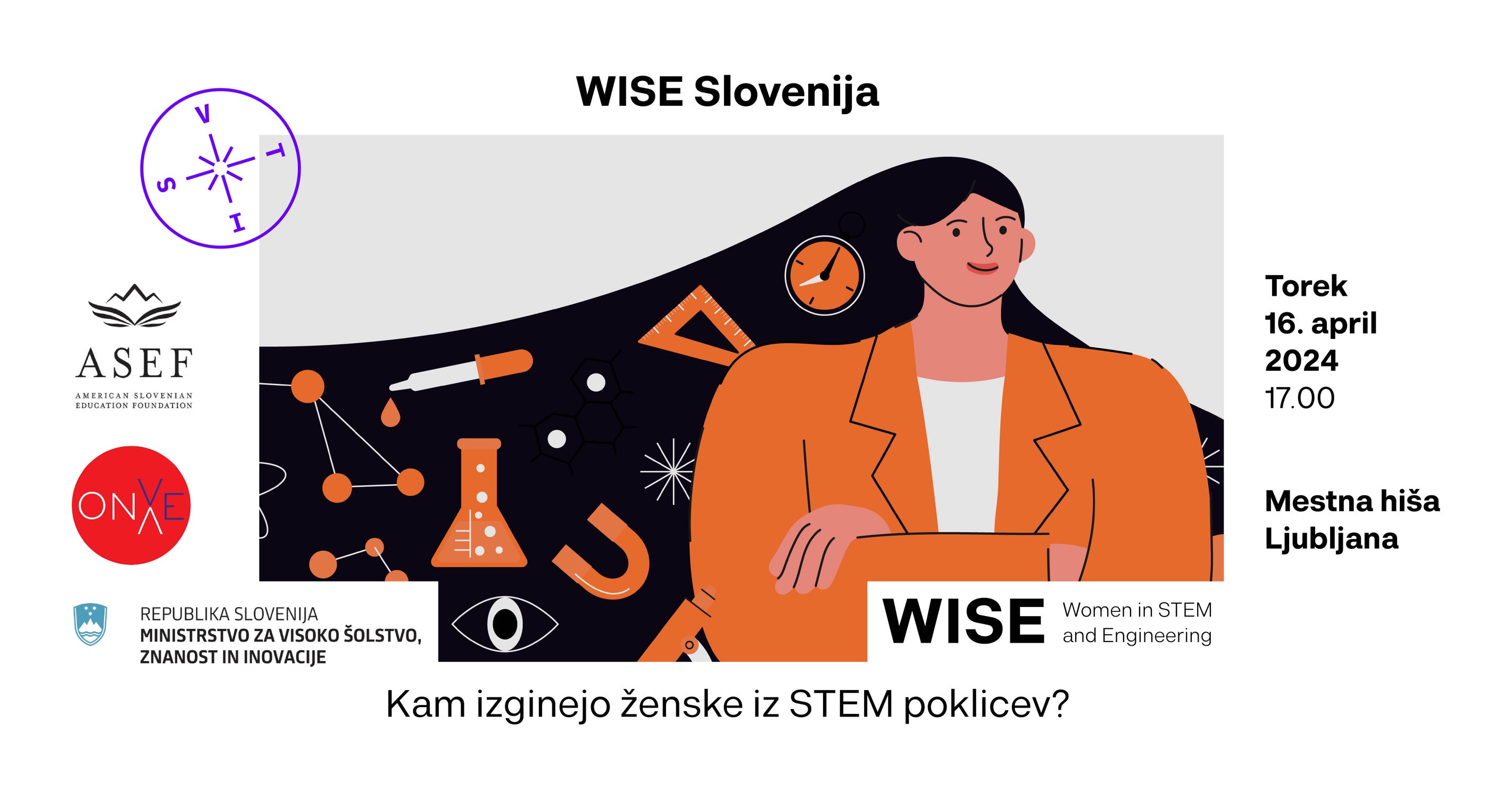
My blog once again took a backseat to another of my projects in March and April, because I was organising a joint panel discussion event on the topic of women in STEM (Science, Technology, Engineering and Mathematics) in Slovenia. Because the topic is important, I wanted to share it here as well.
It all started back in the end of 2022 when I first joined VTIS – Association of Slovenians Educated Abroad and started volunteering in two interest groups in 2023. VTIS is an non-profit, volunteer-based NGO association of experts focused on fostering knowledge circulation and connections between Slovenia and the world, which brings together those of us who studied or worked abroad and are either still there or have since returned back to Slovenia.
VTIS Association – returning home after living abroad
As you might already know, I did my MSc studies in the UK and Sweden for 2 years and then decided to return home to pursue my PhD. Even though I wasn’t gone very long, the return home was an unexpectedly strange mental transition – I wrote a bit about it here back in 2019, which was further complicated by the Covid pandemic situation. Over time I noticed that my new perspective and mentality no longer matched the typical Slovenian way of thinking and doing things, so I felt a bit alienated at times. Although I was happy to be back and still am, I do miss certain aspects of living abroad and appreciate others here at home that are difficult to explain to someone who has never left the country.
By joining the VTIS association, I found a community of people who understand me and share my feelings, as we are all a product of our shared Slovenian cultural background and our unique experiences abroad. Those of us who are active as volunteers provide relocation support for members and organise educational and social events in different countries, as well as career roadshows for students deciding to go abroad for the first time and an annual research conference in Slovenia. We collaborate with the Slovenian government offices, local embassies and expat communities and partner companies.
In recent years VTIS has also began to focus on organised action and going a step further beyond networking. We wish to facilitate change in Slovenia by raising awareness of social issues and best practices we’ve picked up abroad, and by providing public policy-shaping suggestions, all while remaining independent and apolitical. We aim to connect and empower Slovenians to make a positive impact at home and abroad, and to change the general perception of expats as brain drain, to be perceived as opportunities for collaboration and growth instead. Personally I see volunteering at VTIS as an effective way to contribute and give something back to society with my time, as well as a good networking and learning opportunity, as there is always more to learn from all the proactive and inspiring people around me and the projects were create together. For example, the event in this blog post was a great opportunity to improve my project management, public speaking, event organisation and leadership skills and connect with a lot of new people.
The WISE project
This year I was invited to take over as the chair of the VTIS Slovenia local committee and became part of the new WISE – Women in STEM and Engineering project, which is focused on the issues and solutions for gender inequality in STEM professions and the active implementation of best practices. The WISE project was initiated by a fellow VTIS member Polona Šafarič Tepeš, PhD, a biomedical researcher in the USA, who coordinated the first WISE panel discussion event in New York as part of the United Nations celebration of the annual International Day of Girls and Women in STEM (11th of February). That was the first WISE event in 2024, entitled ‘Empowering Women and Girls in Science and in Leadership: From Discovery to the Market’, which highlighted the importance of empowering women to not only choose a profession in STEM, but to also perceive themselves as future leaders and not just scientists or engineers. The second event was held in Slovenia and the third is planned in the UK in May, coordinated by Ajda Pristavec.
WISE SLovenia: ‘Why do women disappear from STEM professions?’, a panel discussion event
The Slovenian WISE event was held on the 16th of April 2024 in the Ljubljana City Hall. It was coordinated by me and Kaja Skerlj and organised as a joint venture of the VTIS association, ONA VE – a network of Slovenian female experts, the Slovenian Ministry of Higher Education, Science and Innovation and the American Slovenian Education Foundation ASEF. As a product and UX designer and a mechanical engineer, Kaja and I both face many of the issues highlighted in the WISE project ourselves, so the title we chose for the panel discussion was ‘Kam izginejo ženske iz STEM poklicev?/Why do women disappear from STEM professions?’. The title and the following account of events is loosely translated from my LinkedIn posts in Slovenian.
Currently more and more female students are enroling and successfully completing their studies in STEM fields, but the market share of women in STEM professions is still very low. The panel discussion therefore focused on why women don’t stay in STEM professions long-term and why there is a lack of women higher up in the STEM hierarchy, both in academia and in the business and industry sectors. What barriers to successful STEM careers do we commonly imagine, which ones do women actually face and how can they successfully overcome them? Additional topics of discussion included the lack of female role models (professors, CEOs, COOs and CTOs, senior engineers and leaders etc.), the perception of successful women in the media and the public, the stereotyping of women in the workplace, and what the system, i.e. the state, the general society and women themselves can do to better support women in their pursuit of building a successful STEM career.
We invited 4 eminent female STEM experts at different stages of their career paths:
- Majda Pavlin, PhD: researcher at the Institute for Civil Engineering and member of the Equal Opportunities in Science committee at the Slovenian Ministry of Higher Education, Science and Innovation.
- Assoc. Prof. Marina Klemenčič, PhD: analytical project lead at Novartis, biochemistry researcher at UL, youth mentor with ASEF and active member of the VTIS association with rich international work experience.
- Prof. Saša Novak, PhD: scientific advisor at the Department of Nanostructured Materials at the Institute of Jožef Stefan, science communication advisor, full professor at MPŠ and member of ONA VE.
- Simona Kek: data scientist at Outbrain, finalist for the Slovenian Female Engineer of the Year 2023 and co-founder of Club Ada, a community for women in STEM.
Impressions from the event


I am happy to say that the event was a success despite the unexpectedly bad weather (it started snowing in mid-April) and we attracted about 50 visitors. The panel discussion lasted for 2 hours, followed by refreshments and networking time. The title of the event stimulated debate and awareness that while there are more and more women in STEM professions, it is often harder for us to get ahead due to societal pressures and lack of self-confidence, as we still do not have equal opportunities.
Throughout the organisation process, it was my wish was that the event would not only raise awareness, but also have a positive and useful impact. The panellists gave a lot of advice for a successful career in STEM and stressed the importance of supportive environment, both at home and in the workplace, as well as at the societal and systemic level:
- Assoc. Prof. Marina Klemenčič, PhD: If knowledge is our personal value, it is also a source of our self-confidence and worth that no one can take away from us.
- Simona Kek: All of us create our own path. It is important to maintain the right perspective – what can we influence, what can we do better and what kind of people we choose to keep around us.
- Prof. Saša Novak, PhD: We have already broken through the glass ceiling, but we still have glass walls to break – ensuring the support of those around us so that we can build our careers free from criticism and judgement of our choices while balancing a successful career and motherhood.
- Majda Pavlin, PhD: We should do what feels right to us. We need to foster interest in STEM and teach children that a typical person in STEM professions can look like anyone from a young age. Children need to be shown all the possibilities and we need to do more in the field of education and promotion of science.
In conclusion, I would like to once again thank everyone who contributed to the success of the event and took the time to attend it. A bit thank you also to Anita Senk, PhD from VTIS and Duša Marjetič from the Slovenian Ministry of Higher Education, Science and Innovation for their great opening remarks, Mateja Malnar Štembal from ONA VE for moderating the panel discussion and the City of Ljubljana for donating the premises. I believe that we all share a duty and a responsibility to co-create an environment of mutual support and empowerment, because real social change always starts in our thoughts and is enacted from the bottom up.
P.S.: I realize that the situation of women in STEM is different in every country, but I feel that it is nonetheless a global inequality issue, so I hope this post has given you some food for thought even if you aren’t based in Slovenia.

Share your thoughts with me