
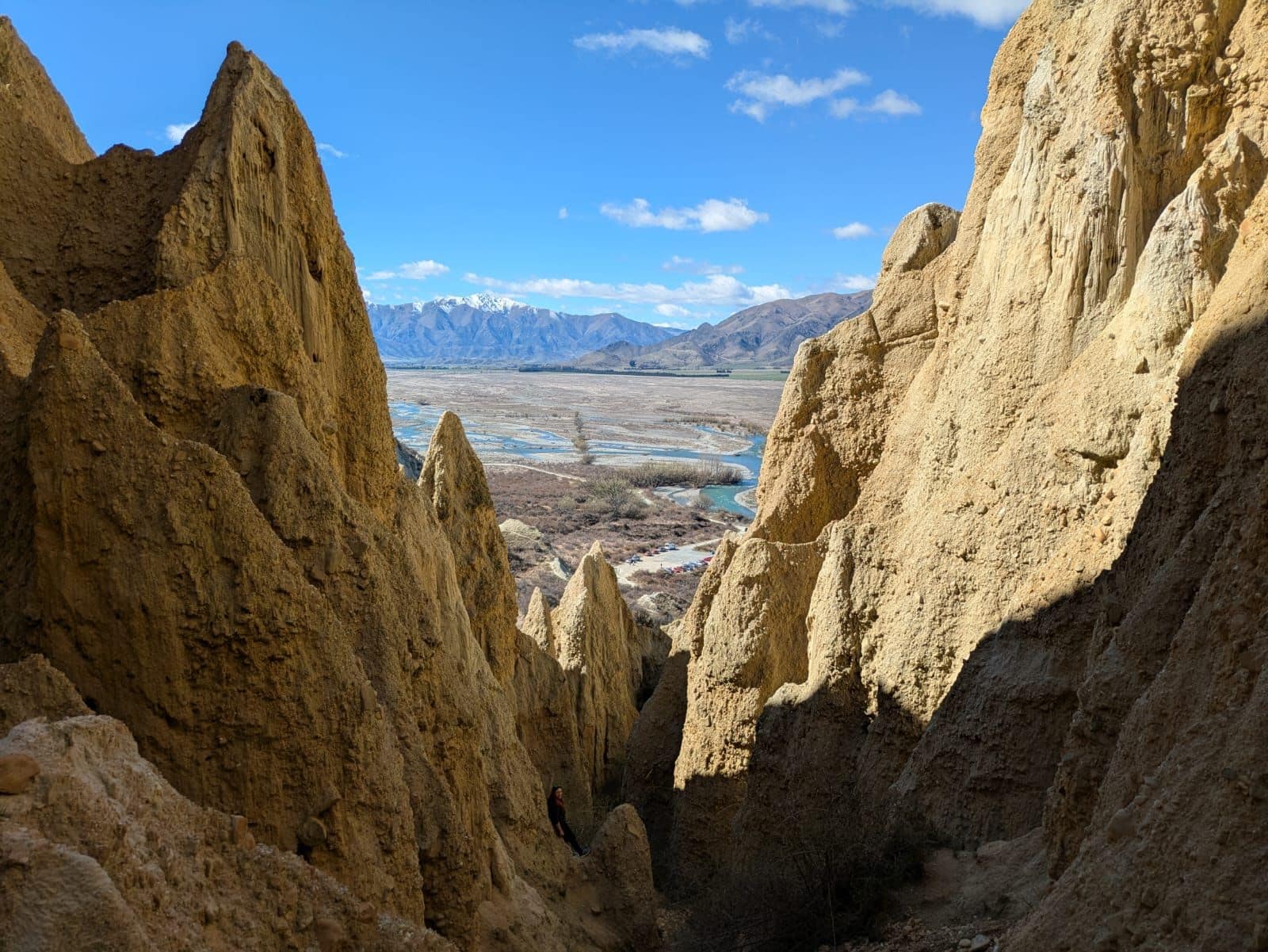
Towering pinnacles and ambitious willow trees.
The Ōmārama Clay Cliffs were one of those random sites I noticed on GoogleMaps when my partner and I were planning the drive to Queenstown during the big New Zealand trip in September 2026. Known as one of the best examples of badlands style erosion for geo nerds, the cliffs are less what you would traditionally expect of a cliff and more a collection of dramatic pinnacles, narrow ravines and dusty layers of sediments rich with clay. Badlands style erosion is what happens when wind and rain chip away at soft rock and river gravel over millions of years – because such sediments are only loosely held together and composed of conglomerates, sand and silt, the resulting eroded shapes are sharp, contrasting and make for a really fun labyrinth to explore.
The cliffs are located on public land and can be accessed via an unsealed private road – it’s a couple of kilometres only and the road is not bad, but it is extremely dusty and there are no toilets or any facilities there, which is rather uncommon for New Zealand natural sights. You have to pay a small fee to visit, which you can either do online or by leaving cash in the honesty box at the access gate (check the latest access info here). The walk from the carpark to the cliffs is relatively easy and shouldn’t take you more than 10 minutes, but it is dusty, gravelly and slippery, so wear sturdy shoes and expect to get dirty, particularly if you want to explore the cliffs too. There is no set track through the cliffs, so you’ll just have to squeeze through one of the entry gaps between the clay pillars and hope for the best. 🙂
IMPRESSIONS OF Clay cliffs


If you are nearby, it’s also worth stopping at lake Wanaka to see that Wanaka tree. It is a popular Instagram tree, which grows alone out of the water close to the shore. A photo of the tree won a New Zealand national photography competition in 2014, but its real claim to fame is that it had sprouted out of a wooden fencepost about 70 years ago, when it was put there to prevent the livestock from wandering. Crack willows are quite good at tolerating wet, even severely waterlogged environments and it seems that this particular wood had more ambition than to remain a simple fencepost, which I can only admire. It is now amongst the world’s most photographed trees, so be prepared to see tourists pulling all sorts of photo stunts around it. Lake Wanaka is New Zealand’s fourth largest lake and a pretty scenic place to visit by itself, plus there are more gorgeous willow trees all-around the lake shore.
That Wanaka tree


Share your thoughts with me