
There would have been no Viking Age without the ships, but how did they do it?
Roskilde is a small Danish city, located about a 30 minute drive away from Copenhagen, which makes it perfect for a day trip if you are ever there. That is exactly what my partner and I did in May 2024, when we were on a short holiday in the capital of Denmark and I can tell you first-hand that the train connections are great and not too expensive.
Back in the time of the Vikings, Roskilde used to be the capital of Denmark (from 11th until the 15th century) and is one of the oldest Danish cities, dating back over a thousand years ago. Nowadays it is an interesting mix of history and rock’n’roll: famous for its UNESCO heritage Gothic cathedral and Viking history on the one hand, and the Roskilde music festival and the Ragnarock museum of rock music and popular culture on the other. Although I love rock music, my partner and I fall firmly into the Viking history nerds tourist category, so that is what you are getting in this post.
However, let’s start with the Roskilde cathedral first, because it is worth it. It was built in the 12th and 13th centuries as the first Gothic cathedral to be built with bricks in the wider Scandinavian area, causing the style to spread from France across the rest of northern Europe. To this day it remains the burial site of the Danish royals and you can see about 40 royal tombs with amazing burial monuments inside. Needless to say, the cathedral is huge and has one of the most beautiful interiors I’ve seen to date. It somehow manages to achieve that elusive blend of intricate, rich details and elegant simplicity, without being tacky or overwhelmingly full of opulence and decorations. Even though every royal tomb alcove is made in a different style, it all somehow works together well as a whole. I definitely recommend that you set aside some time for your visit to really explore everything and read the life stories of the Danish monarchs buried inside, as some of them are quite entertaining.
The Roskilde cathedral


The cathedral also hides several Easter eggs: a cannon ball hanging off the plaque above the burial site of a Danish admiral, which crushed his hip during a battle; an unmarked gravestone said to be the burial place of the mythical helhest, a three-legged ghost horse of ill omens; trolls on a chapel door and many more. As I said, worth exploring in detail, which is not something I often say about churches. 🙂
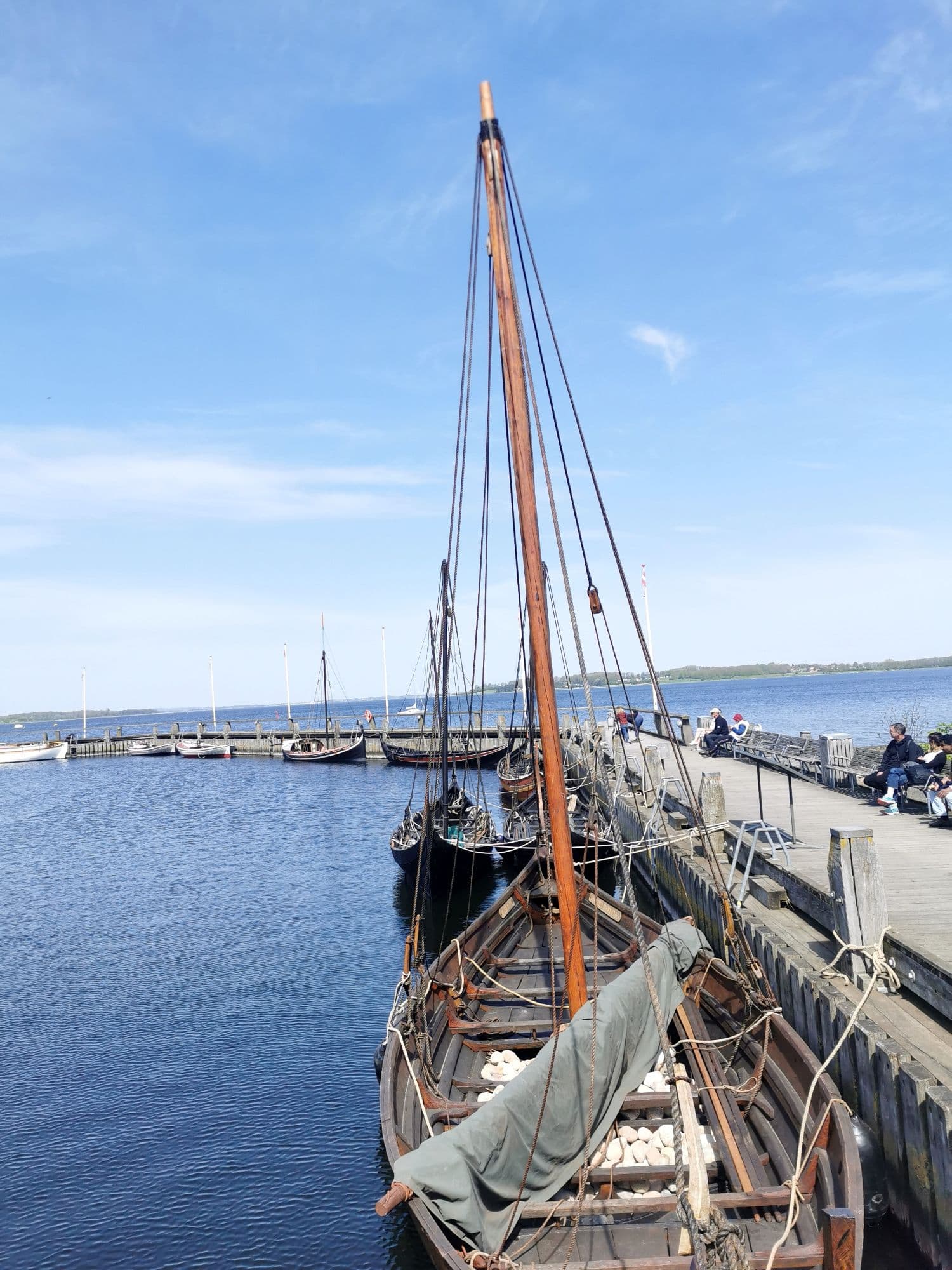
Although the cathedral is a pretty good contender, the Viking ship museum is by far the most interesting thing in Roskilde. It houses the remains of five impressively preserved 11th century Viking ships and an experimental archaeology centre, where they are trying to figure out exactly how the ships were made and used and recreate them. Needless to say, I was worried I’d never get my archaeologist boyfriend out of there…
The Viking ships in Roskilde were recovered from the sea about 20 kilometres out of the city in the 1960s. Research shows that they were sunk in the fjord on purpose, to block the channel and form a defensive barrier against direct attacks from the sea. The ships range in size from 3 metre fishing boats to 15 metre longships and reading about the defensive system they created around them was fascinating. But not only is the museum really interesting, it is also alive. The experimental archaeology centre is an active boatyard, where you can even attend a practical wood-working workshop or sail on one of the recreated Viking ships into the bay. As they say, the best way to learn about something is to try and make it yourself, and I am pretty sure those people have one of the most fun jobs in the world making history come alive. Also, the museum cafe has a very nice selection of Viking-inspired food.
THE Viking ship museum


On the way back to the train station we also found a small 1920s historical shop called Lützhøfts old grocery shop. The shop dates back to 1892 and was operational until 1979. Today it is a living museum – it looks just like it did in the 1920s inside and you can still buy a lot of historical bulk goods just like in the old times. The owner is super friendly and very interested in hearing about historical shopping heritage from different countries, so definitely try and have a chat with him. I was surprised to recognise several products that my grandparents talked about from Yugoslavian times, as well as a lot of the Scandinavian vintage brands that I have already seen in a similar historical shop in Luleå, Sweden when I lived there. In the end we bought a nice ceramic candlestick and some vintage parts for a light fixture that my boyfriend had apparently been looking for everywhere and couldn’t find it, so we all had a good laugh about it.
Lützhøfts Old Grocery Shop


Share your thoughts with me