
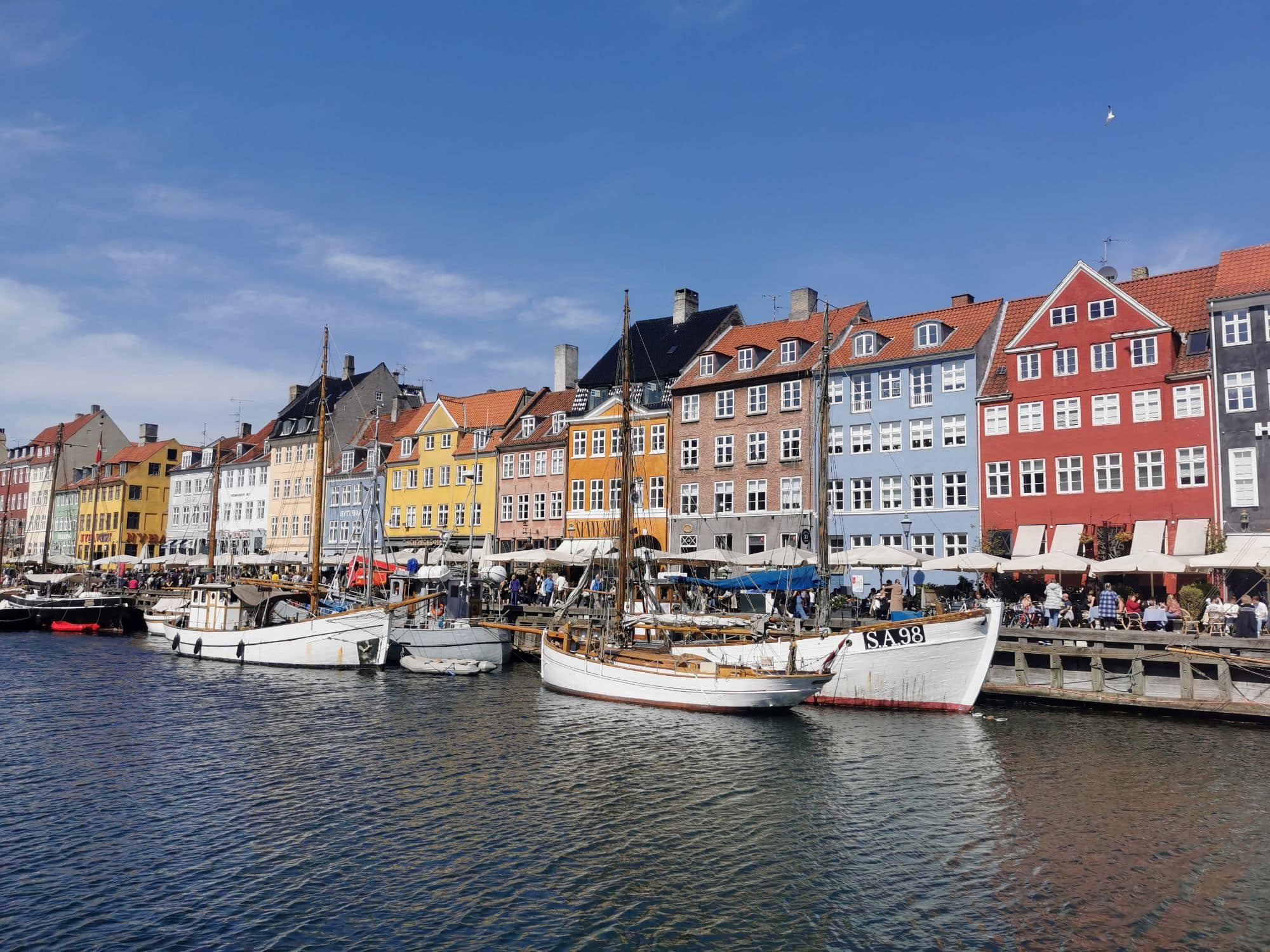
The Danish capital city, caught between fairytales and rushing modernity.
For the 1st of May holidays this year my boyfriend and I chose Copenhagen, the vibrant capital of Denmark. Like in all capital cities, there is way too much to do in Copenhagen, but unlike in many, that generic tourist card is actually worth buying. We did the tourism math and ended up buying the 3-day Copenhagen card, which included access to over 80 attractions and all means of public transport, even outside of the city to an extent – we also used it to visit Roskilde. In the ended we saved quite a bit of money with it, but we also visited several attractions we wouldn’t have otherwise, so who knows if the math was actually mathin’… Either way, it was great and this post is going to be a long one.
The first things you’ll notice about the city centre of Copenhagen are all the beautiful canals and way too many palaces, because Denmark is one of the oldest monarchies in the world. It would take 3 days to visit all the royal attractions alone, so in the end we decided to explore the Rosenborg castle and the Christiansborg palace.
The Christiansborg palace is located on a tiny island named Slotsholmen and currently houses the Danish parliament and some other important state offices, so the royal reception rooms are still used to entertain foreign visitors. It used to be the royal home, but nowadays the royal family lives in the Amalienborg palace, which we didn’t visit, but we did see a tourist getting arrested by the royal guard in the courtyard there for trying to take a photo of the interior through the window with a selfie stick. Also, this is the third iteration of the Christiansborg palace as it had to be almost completely rebuilt after it burnt down in devastating fires – twice.
The Christiansborg palace complex is huge and includes the royal reception rooms, the stables, the kitchen and the chapel, as well as the ruins of the 12th century castle that preceded the Christiansborg palace and Christian IV’s brewery. For me the royal reception rooms, the Queen’s library and the royal kitchen were the most interesting parts. The library is classically beautiful, but Great hall in the royal reception rooms has a unique blend of traditional decor and modern tapestries. There are 17 tapestries depicting over a 1000 years of Danish history in bright, very modern colours and style, which were a gift for Queen Margrethe’s 50th birthday and are based on drawings by artist Bjørn Nørgaard. Surprisingly, the blend of styles and eras works and I really enjoyed it.


I also loved the royal kitchen, because there was a great documentary on the topic of downstairs service life. They went deep into the details of how a formal royal banquet or dinner is prepared: how the menu is chosen and how they manage to provide the perfect identical hot dishes for almost 100 people attending the meal at the same time.
In contrast, the Rosenborg castle is a smaller castle from the 1600s, which was originally built as a summer residence. Its interior is really gorgeous and you can apparently take a virtual tour here. My favourite part was the Knight’s hall with 3 badass silver lion statues in front of the royal thrones and several intricate (traditional) naval tapestries. There were also a couple of very inspired paintings of horses, clearly drawn by painters who had zero understanding of how horse leg joints work. Moreover, the Rosenborg castle houses the royal treasury with some very fancy crowns.
THE Royal splendour


The most iconic canal in the city is the Nyhavn canal and that is where the cover photo is from. Because it was included in the Copenhagen card, we took a boat tour through the canal on one of those overcrowded giant tourist boats with an exhausted but friendly guide speaking historical facts into the void of people chattering all over each other and taking obnoxious selfies. As you can probably tell, I didn’t enjoy it, although the canals are very nice. If you decide to explore them by water though, I’d definitely recommend renting a smaller boat for a better experience.
We also visited the Botanical garden, a part of a large park perfect for chilling in with a cup of takeaway coffee. There is a huge tropical greenhouse with some of the largest ferns I’ve ever seen, which is absolutely worth a visit, even if it is extremely humid. On the opposite end of the spectrum was the National museum, which was a top priority on our list because my partner is an archaeologist and they have a huge Viking section, as you would expect for Denmark. The Viking section and the lower floors of the museum are really interesting even for casual history fans, but the older Middle Ages section upstairs still hasn’t been renovated. It is one of those classic old-school museum exhibitions with walls of small text and barely any structure, but I had a good laugh about some of the English translations as saddles and spurs were listed as “horse furniture”.
Instead of paying to climb up the tower of the famous Church of our saviour, we found the best view over Copenhagen at the Original Coffee cafe at Illum rooftop. The church is free to enter and definitely worth a look, but if you want to climb the tower with its outside staircase, you need to book and pay for your visit in advance, as it gets quite crowded and they accept only a limited number of visitors due to the narrow exposed stairs. We also explored the star-shaped military citadel Kastellet, which is one of the best preserved fortresses in northern Europe and makes for a nice walk by the sea, as well as the more modern parts of the city around the Black diamond, the main building of the Danish royal library and its cultural centre. I am honestly not a big fan of the humongous, cold and clear-cut modern architecture, so you won’t see it much in my photos in this post, but it is a fairly large part of the city centre.
IMPRESSIONS OF COPENHAGEN


Of course no visit to Copenhagen is complete without Hans Christian Andersen, the world-famous fairy tale writer, even though he was actually born in Odense, which I still need to visit someday. Even though we didn’t have time to visit Odense, we got a nice tour through Andersen’s life at the Ripley’s H. C. Andersen experience, which is a part of the Ripley’s Believe it or not museum in Copenhagen. Robert Ripley was an American cartoonist, amateur anthropologist and TV personality, who became famous in the 1920s for uncovering bizarre facts and his collection of curiosities from all around the world. We randomly visited the museum because it was included in the Copenhagen card, and I have to say that Ripley’s “fun facts” haven’t aged well, as most of them are over-exaggerated, blatantly fake and firmly on the side of what we would consider politically incorrect today. I guess some people might still find the museum fun, but I just felt a bit dumber after coming out, so the less said about it, the better. The Andersen experience was something else though, and it was a really beautiful and well-presented interactive walk through his life and stories, so I would definitely recommend that.
I grew up on Andersen’s stories and you are all probably familiar with the one about the Little mermaid, which also has a Disney version. Well, the Little mermaid statue in the harbour is now one of Copenhagen’s top 10 tourist attractions and you would not believe the crowds of tourists that she attracts. The statue was a gift to the city by the brewer Carl Jacobsen, the one behind the Carlsberg beer and the entire industrial district in Copenhagen, which is also worth a visit for its fancy Elephant gate, by the way. Apparently Jacobsen fell in love with the story during a ballet performance and commissioned the statue in 1913 and she has been sitting on a rock ever since. A couple of hundred meters away on the other side of the pier is her counterpart, the genetically modified Little mermaid, with a group of other similarly funky statues providing a provocative take on the postmodern society.


“I know what you want. It is very stupid of you, but you shall have your way, and it will bring you to sorrow, my pretty princess. – The sea witch.”
H. C. Andersen – The Little Mermaid
Another attraction we probably wouldn’t have visited if it wasn’t included in the Copenhagen card was the Glyptoteket and I am very glad we did. The Glyptoteket is an art and sculpture museum with a gorgeous indoor garden. It has a nice collection of classic and modern art, including some sculptures by Auguste Rodin, which I primarily wanted to see, but it also is an experience in itself. The whole space is beautiful and the art placement compliments it very well, so just walking through all the rooms is a pleasant experience for the senses even if you are not a huge art fan.
Also, there is an Easter egg to be found: the nose collection. The nose is often the most vulnerable piece of a sculpture and back in the day when the noses broke off, curators and art dealers used to replace them with a facsimile. Today that is regarded as a major crime against the original sculpture, so the restoration staff at Glyptoteket have removed all the fake noses, but they have chosen to preserve them in the nose collection.
Glyptoteket


Now onwards to the one major attraction we would have visited for sure, with or without the Copenhagen card, because I absolutely love submarines: the military vessels at Holmen, Copenhagen’s still semi-active naval base. Much like I had to suffer through the entire National museum archaeology section and all the Viking history stuff, my boyfriend had to patiently explore every nook and cranny of the 3 vessels with me.
There are 2 naval battleships from the Cold War, a giant wooden mast crane from 1749 and most importantly, the submarine from the 90s, which was only decommissioned in 2004 as the last submarine in Danish service. Saelen is a small diesel-electric submarine with 8 torpedoes, which is also the only Danish submarine to have participated in hostilities, as it was deployed in the Cold War, in NATO operations in the Mediterranean region and in the second war in Iraq. Its violent past aside, it is a sub-sea beauty for coastal operations where it could remain fully hidden in all of its cramped-conditions glory. Then there’s the Peder Skram frigate, the first warship in the world to use a combination of diesel engines and gas turbines, which served as a Royal Navy flag ship and a coordination centre for large operations during the Cold War between 1966 and 1988. It had a crew of 200, so it is huge and of course is a very interesting place to explore, as you can have look inside everywhere, from the engine room to the tactical command centre. The third one is a smaller attack craft named Sehested, which was armed to the teeth and served as a part of the naval defence. All in all you will need a few hours if you want to see everything, but it is totally worth it if you are into this sort of stuff.
In terms of other engineering nerd locations in Copenhagen, there are also the Danish museum of science and technology, the Maritime museum and the Danish War museum. We did not have time to visit those three, but we visited another one that I figured deserved a separate post: CopenHill, the mega waste incineration power plant with an all-year ski slope and urban recreation centre on top.
MILITARY vessels at holmen


Besides the submarine, my favourite thing in Copenhagen were the trolls and I was pretty sad that we didn’t have time to find more of them. The trolls are created out of recycled trash by an artist named Thomas Dambo and there are now over a 100 giant troll sculptures all over the world. The first one we saw lives in Christiania, Copenhagen’s squat turned autonomous free town in the 70s on the site of abandoned military barracks. Christiania was notorious for drug use and organised crime activities for the past couple of decades, but became a (controversial) tourist attraction despite that, due to its alternative culture events and preserved 70s vibe.
About a 1000 people live in Christiania nowadays and its community is determined to make it safer and reduce the level of crime. After years of negotiations with the Danish government and the Copenhagen police, they created the Freetown Christiania foundation on the 40th anniversary of Christiania to better manage the area and have now started construction for new social housing. The infamous Pusher street, which used to be the drug dealing central, was already being dug up for construction while we were there, so I’d say they are on the right path. It reminded me a lot of Metelkova, a smaller and less notorious ex-military barracks squat turned alternative culture centre in my home town where I spent a lot of time as a teenager, so I guess if we could do it, so can they.
We found the next troll in the middle of a kindergarten playground where she apparently feeds on kids’ pacifiers and the third one dragging a boat to the sea in an abandoned construction site next to the Copenhagen cruise ship pier. There are 6 trolls altogether in and around Copenhagen and if you fancy a treasure hunt, you can try to find all of them, but some of them are a bit difficult to reach with public transport.
Trolls and christiania


Last but not least, the famous Tivoli gardens, which are amongst the oldest amusement parks in the world and have been operating since 1843. The entrance fee is quite expensive and doesn’t include any rides on the attractions, so we were initially planning to skip the visit, but it was included in the Copenhagen card. After that, I suppose it was go big or go home, so we took a ride on 3 roller coasters.
The Demon was the most exciting one, but I was most interested in the oldest one. Simply named “the Roller Coaster”, it is one of the oldest wooden roller coasters still operating in the world since 1914 and is surprisingly fun for such an old ride. It takes the form of an Alpine-style mountain station and takes you inside the mountain, to visit a mine I guess, but the unique part is that there needs to be an operator present onboard every ride to manually brake on fast corners. So, even though the Tivoli gardens are quite expensive, they are quite fun and also very magical in a very aesthetic way, not in the cheap, overdone tacky way common to many amusement parks. If you can afford it and you like a bit of adrenaline, I would definitely recommend a visit, particularly at night with all the lights.
Tivoli gardens


Share your thoughts with me