
Skiing on top of a trash mountain – a case for environmental hedonism?
One of the last stops on our holiday in Denmark was CopenHill, Copenhagen‘s ambitious waste-to-energy power plant and urban recreation centre project. As an engineer I obviously couldn’t miss the chance to check it out, but it is a worthy attraction for anyone and a true trend-setting building in the global sense. Advertised as the best view over Copenhagen and featuring the world’s tallest artificial climbing wall, an all-year ski slope complete with a ski lift and sports equipment rental shop and a rooftop bar, it is free to visit and certainly not what you’d normally expect from what is essentially a trash burning plant.
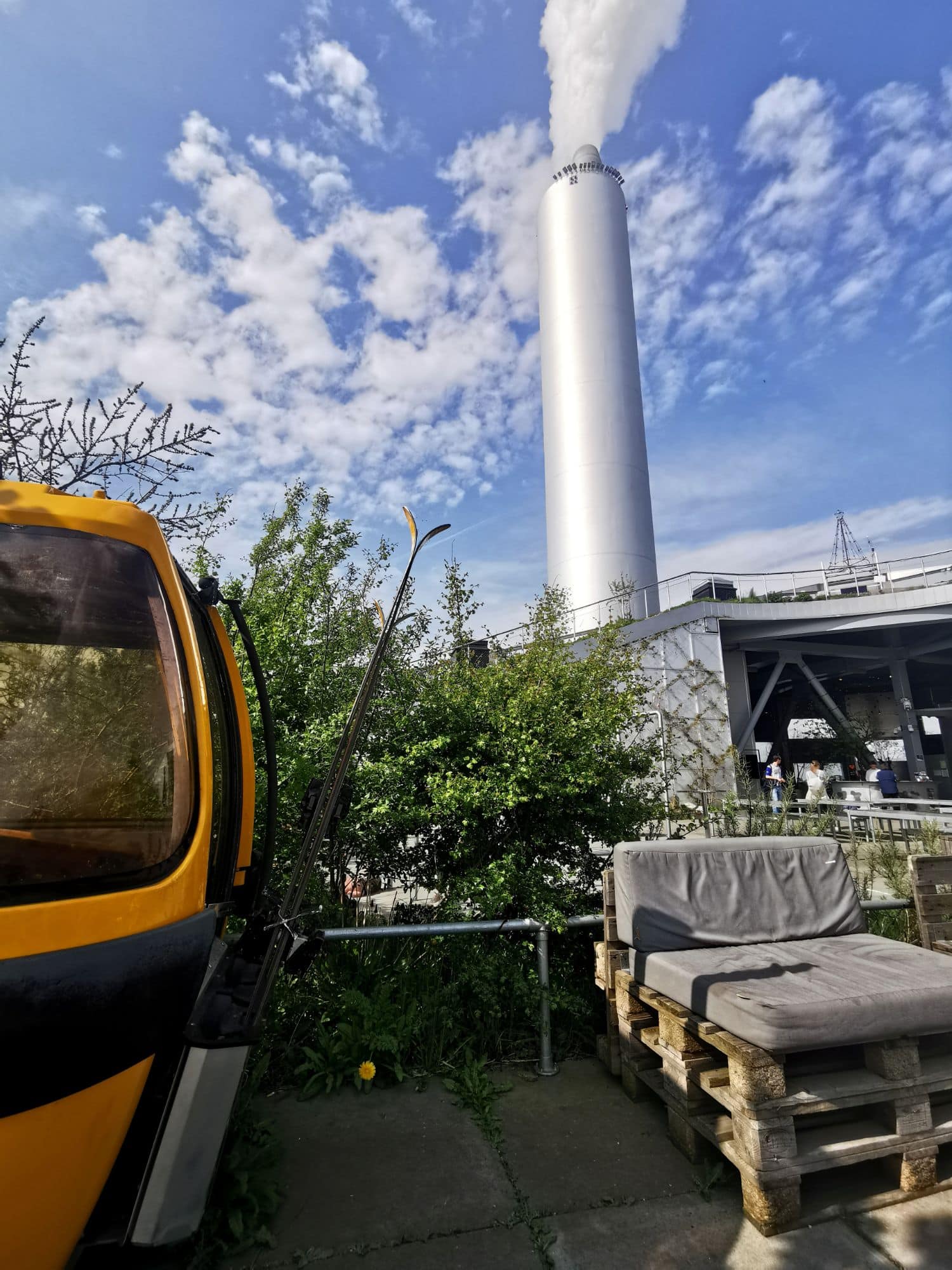
CopenHill officially opened in 2019, replacing an older plant at the same location. It was one of the most expensive construction projects in Denmark’ recent history and is hailed as their foremost environmental initiative. It is undoubtedly the cleanest waste incinerating plant in the world, as it far outperforms all the best practices in the industry and I can confirm that you can barely smell the tepid trash smell, even when approaching the plant from downwind, as the incinerator steam exhaust is filtered and cleaned as much as possible before it is released into the air through the 123-metre tall chimney. From the outside, the plant looks incredibly fancy, with a textured metal facade full of nooks and crannies for crawling plants and animals to inhabit, and a curving S-shaped artificial membrane ski slope in various shades of green, amidst real trees and greenery that give the overall look of a futuristic biomechanical local park.
You can take a glass elevator up to the rooftop through the white, monochrome silver-plated sterile machinery guts of the plant, which hide the furnaces and turbines converting waste to energy and heat. If it weren’t for the ever-present trash smell, which is certainly noticeable on the inside, and a surprisingly low amount of noise for such a big plant, I would have thought the plant was somehow dormant, even though it is operational 24 hours a day. On the rooftop rising 85 meters above sea level, which is a lot of height for Denmark, the bar/restaurant has a reasonably authentic apres-ski atmosphere with the iconic yellow ski lift cabins and lounge chairs for sunbathing. Further down is where the ski slope begins, as well as some very confusing air shaft placements blowing out trash smell from the inside of the plant when you pass by on the stairs leading downhill. The smell impact is rather low and quickly forgotten, equivalent to passing an overfilled trash container on the street rather than a full-blown landfill, but due to the unusually high level of attention to detail apparent in the design of the whole gigantic endeavour, I couldn’t help but wonder: do the administrative offices and the environmental education centre under the rooftop bar also have to deal with this subtle trash smell and is it, perhaps, on purpose?


The whole shape of CopenHill was designed to mimic a natural hill slope through careful positioning of machinery at different height levels so that the building is in fact, a well manicured Danish trash mountain in a land where there are no mountains, and the metaphor is palpable.
The BIG group that led the architectural effort calls CopenHill a herald of “hedonistic sustainability” architecture, but aren’t hedonism and excess precisely what got us into this environmental mess to begin with? While I love and fully support the new trend of mixed-use industrial buildings, I just can’t get over the fact that statistics already show that CopenHill was designed too big in order to accommodate the ski slope and recreational activities. Spanning over 41.000 square meters, CopenHill can burn over 440.000 tons of waste per year, with the capacity to supply electricity and district heating to 150.000 homes, which is roughly a quarter of Copenhagen’s heating needs. However, coupled with Denmark’s goals of 70% waste recycling, they’ve already had to import waste from overseas and even burn biomass, as you simply cannot afford to stop a massive, overly expensive 24-hour plant which is now firmly a part of the city’s stable energy supply projections. Not to mention that it is difficult to transport and use any excess heat and electricity without significant losses.
A smaller urban recreation centre on top of a smaller waste-to energy plant could have served just as well, but then it wouldn’t have been so impressive and record-breaking and probably wouldn’t have gotten built. The realisation of the CopenHill project took almost a decade and involved a lot of new technological development, not only on the waste incineration front, but also in terms of the artificial ski slope membrane surface, which is already experiencing some issues with wear and tear after only a few years. Also, both the slope and the skiing equipment need to be excessively covered in silicone for a good experience and the result is an interesting, sticky artificial mess, highlighting the fact that it is not so easy to recreate skiing outside of winter conditions as this sport will be one of the definitive victims of climate change. Which is a great shame, as I enjoy skiing, but I am not prepared to support the excessive waste of energy inherent in ski resorts entirely based on artifical snow, so someone out there will just have to step up their tribology efforts and develop a better artificial ski slope surface. Tribology is the science of surface and lubrication engineering for friction and wear control and also the field of mechanical engineering I specialised in, so this visit to CopenHill was particularly interesting for me.


So is the only way to get ambitious, ground-breaking green projects funded and built properly to fluff them up and over-plan them beyond their intended function, and thus beyond their intended sustainability impact?
The aim of building a ski slope and a whole urban recreation centre on top of a waste incinerator in the middle of a city was to showcase that waste incinerators can be made clean and safe enough with modern technology, since waste incineration is a controversial approach to waste management. For CopenHill, pollution does not appear to be a problem, at least according to current measurements, and using waste heat has already lowered the environmental footprint of Copenhagen compared to heating up homes with thermal power plants. On the other hand, importing waste and burning biomass just to keep the plant going has unnecessarily driven it up again. Although some environmentalists are decidedly against waste incinerators, I think there will have to be a place for them in our greener future, as we simply cannot recycle 100% of our waste and burning it instead of fossil fuels and biomass just kills two birds with one stone, IF it is done right. And “right” apparently can be done, as proven by CopenHill, so despite all of its flaws, it is, in my opinion, still a very interesting step forward for this technology and a step towards a more sustainable future.
But would CopenHill really be as clean and as ground-breaking, if it was just another urban waste incinerator plant in a smaller town, without all the added pageantry, or would it have become another unintended source of air pollution due to all the costs and corners that would have been cut during its realisation – because what does it matter, right? I think we all know the answer here and this lack of social responsibility and accountability for the (mis)management of large infrastructure projects is the real problem that we will need to solve to attain a greener future.
Last but not least, one of the aims of CopenHill’s futuristic design was to promote awareness of our overconsumption as a society. I cannot imagine that the aim was meant to be quite so literal, as the main thing it now draws attention to is its own overconsumption. Perhaps that in itself is a metaphor for our current approach to sustainability and a reflection of the hubris that we will need to fix.

Share your thoughts with me