
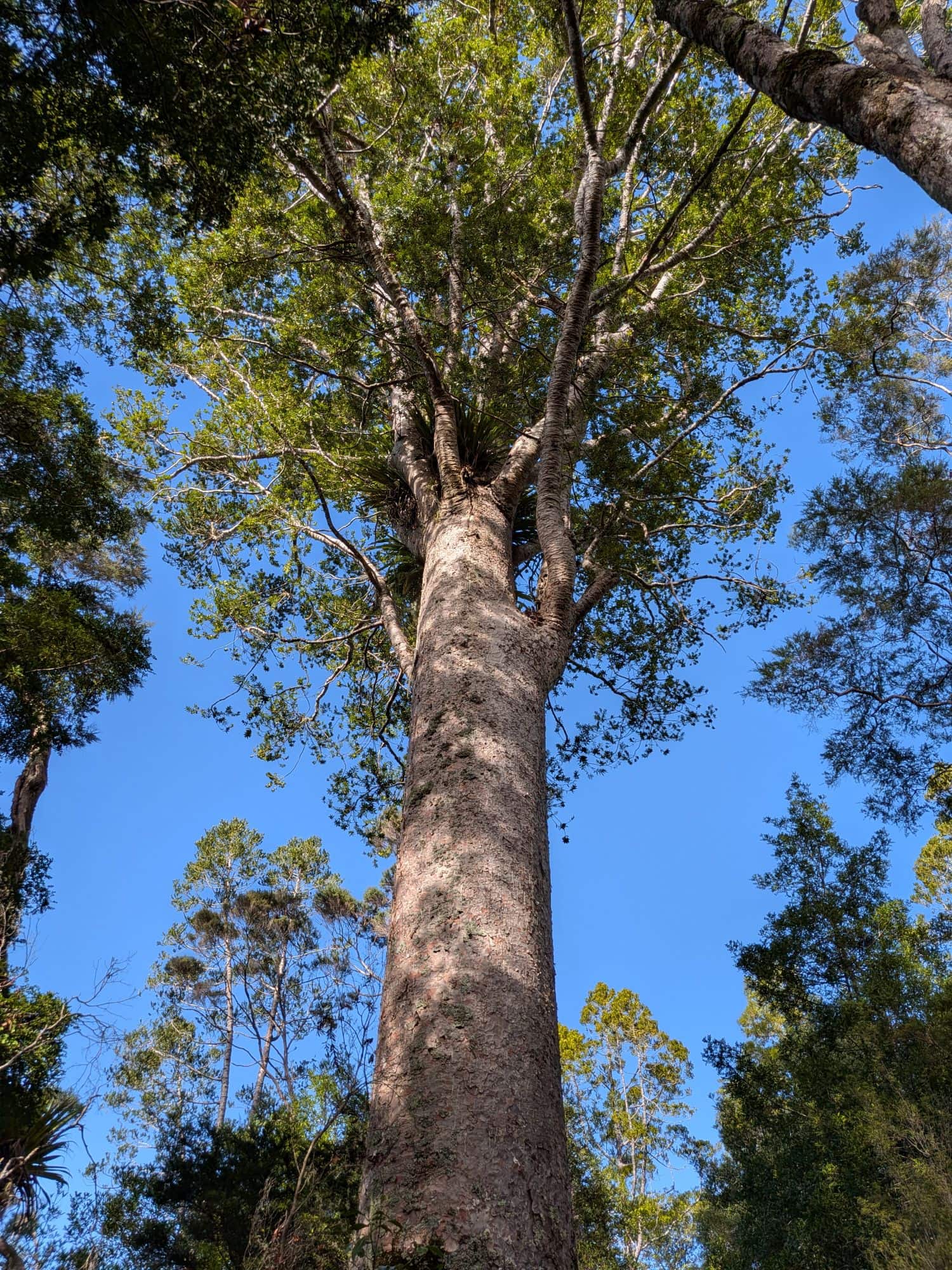
The mighty environmental masterminds that think in centuries.
You might know that New Zealand and Australia are famous for stringent biosecurity checks upon entry, all to protect their unique flora and fauna. Well, one of the reasons are the kauri trees, which are pretty aggressive ecosystem engineers. We went to visit the trees at the Opua kauri walk, one of several tracks with a cluster of kauris.
Kauri trees are amongst the world’s most monumental trees. Much like sequoias, they can grow to over 50 metres tall and over 16 metres wide in diameter, and they live for over 2000 years. They are native to the northern parts of the New Zealand north island and there used to be entire forests everywhere, before the Europeans arrived in the 18th century and figured out that the kauris are great for ship building because they grow incredibly straight, which led to excessive logging and regeneration has been a slow and concentrated effort since then. The more mature kauris are quite easy to recognise due to their specific striped bark that you can see in the photos below. They are coniferous, but don’t look anything like pine trees, and they change shape when they mature, going from cone-shaped growth to dropping all their lower branches once they reach enough height to tower over all the other trees with their wide crown-canopy. Such forest giants are impossible to miss once you figure out what to look for.
The trees owe their longevity to some fascinating evolutionary adaptations, such as full-on ecosystem engineering. They can radically alter the soil and conditions around them to eliminate the competition of faster growing species. Kauri trees can also heal small cuts and damages with their kauri gum resin and peel off their bark to self-clean and defend against predatory vines. Over centuries, a single kauri tree will drop so many leaves, bark peel and resin that its litter will form a mound up to 2 metres high around the trunk. The kauri litter is very slow to decompose and turns the surrounding soil highly acidic when rainwater passes through it, washing away all the nutrients deep into the subsoil where most other plant roots cannot reach them. The tree essentially creates a wasteland around itself, while simultaneously forming deep root systems with mycorrhizal fungi to extract the sparse nutrients and take over the entire forest in the long-term. This has lead to the evolution of some unique species that thrive in the kauri-engineered environment, such as the giant kauri snail or specific types of grass, orchids and decay fungi. Remains of ancient kauri trees have also helped scientists date the last event of Earth’s magnetic pole reversal (an interesting read here). All in all, absolutely epic trees worth a visit and even more worthy of our respect.
Opua kauri walk


The Opua kauri walk is a very easy, short 20-minute return track with lots of young kauri on both sides and a giant one with an observation deck at the end. Unfortunately, the kauri trees are threatened by the kauri dieback disease, a type of mould that attacks the deep root system and eventually starves the tree. It is passed around through soil contamination, so anything from animal movement to dirty hiking boots and equipment can bring in the pathogen from other areas – hence the clever cleaning station at the entrance of the track that you can see in the photo above. These cleaning stations are located at various nature tracks and should be used to clean and disinfect your shoes, although the best thing you can do to protect the trees is to stay on the designated tracks and help protect the trees so that they can live out their impressive lifespan.
If you are nearby, it is also worth visiting the Whangarei falls a bit further south. The falls are 26 metres high, with water falling down in gorgeous shimmering curtains when there is enough flow. They are located in a park near the Whangarei town centre and therefore one of New Zealand’s most easily accessible falls. It’s about a 10 minute walk from the parking lot and the waterfalls are a popular swimming spot in the summer, so I imagine it can get quite crowded.
WhangArei falls


Share your thoughts with me