
A quick first glimpse of China.
At the start of the year I challenged myself to write at least 1 blog post per month if possible. This one for August was therefore written last minute during our flight to New Zealand today, a rare direct report, since my travel posts typically get published after several months if not years of delay.
When my partner and I were booking our flights for New Zealand in the beginning of the year, one of the more economic options was to have a longer layover in Beijing with Air China. It turns out that was a pretty good choice, because Air China offers free transit accommodation for long layovers and the hotel we got was really nice. You have to book the transit hotel service in advance and you can check if your flight is eligible here.
We landed at Beijing Capital airport at 4 am, after 10 hours of direct flight from Germany and 2 reasonably edible airplane meals with suspicious attempts at European appetisers (i.e. pickled salami salad). Luckily we both slept most of the way, as the few TV options with English subtitles were mainly action movies and nature documentaries (very zen). Our Air China overlords dimmed the airplane lights and had us close the window blinds at 3 pm to encourage sleep because of the time difference at our destination, and even showed us a healthy stretching video when we woke up, so all in all it was like a government mandated relaxation flight.
Our luggage was checked in to our final destination and as EU citizens we could enter China visa-free for a few days, so once we got our red immigration stamp in the passport and they fully scanned us into their high-tech surveillance system, we proceeded to the Arrivals hall where the Air China transit service folks arranged a free shuttle to take us to our hotel. The free transit hotels are randomly assigned when you apply and we got Beijing Fuyong Yulong International, which is about 20 minutes’ drive away from the airport. We got a full luxury apartment suite with a separate living room and a giant bathtub on the 8th floor – although the room was a bit past its prime, it was really nice and comfortable and we even had free buffet breakfast included. The check-in and check-out times were directly aligned with our flights, they arranged a shuttle back to the airport in the evening and we didn’t have to pay a cent extra anywhere.
The free transit hotel


Since it was our first time in China and we only had a limited amount of time, we booked a private tour at BeijingLayoverTour.com with the help of my friend Katarina who provides tourist services to Slovenian groups travelling to China and vice versa. She also kindly walked me through everything in terms of arriving to China and how to use Alipay for payments and WeChat for communication. Because China has a massive firewall in place, you can’t use western apps on your phone unless you get a travel eSIM that also acts as a VPN. We used N26 travel eSIM and it worked perfectly, but you need to activate it before arrival to China. It’s also best to download and set up all the other apps before arrival, as China no longer regularly uses western credit cards and they are basically cashless in the big cities. With a bit of preparation everything worked smoothly and if you have internet on your phone things are fairly easy to navigate. I can’t imagine doing it without it unless you speak Chinese though. P.S.: bring your own toilet paper for public toilets if you need it.
Our tour guide David picked us up at 8:30 am in a black VW Passat with a chain smoking driver who didn’t speak a word of English except ‘let’s go’. We got really lucky, because it was a cloudy, mildly rainy day, which meant the temperatures were manageable and not too hot and the attractions we visited were not too crowded because end of August is also the end of school holidays for most countries. Our guide was a man after our own heart and did his best to avoid any crowded areas and find us the best photo spots (‘you make photo here now’). He also had a workaround for every entry line and the ticket fees were included in the tour price (we paid about 150 € per person for the whole day, which was not the cheapest, but well worth the money).
We started at the Summer palace, which used to be the imperial summer residence due to its cooler lakeside climate by lake Kunming and proximity to the mountains, first constructed in 1750. The tour and the history explanations were fairly fast paced in the typical Chinese tourist group way, but we got to see a lot (which only made us more inspired to come back for a proper China trip) and the guide spoke English really well and knew a lot about everything. For example, there’s a giant rock that caught the interest of one of the emperors who spent a ton of wealth to bring it to the Summer palace and even had to tear down the door to get it in, which is why the rock is now known for bringing misfortune if you take a photo with it.
Summer palace


When we visited the Long corridor of the Dragon Lady, I was transported right back to reading a historical novel about her when I was a teenager. Empress Dowager Cixi, a.k.a. the Dragon Lady, was one of the few imperial concubines who managed to rise to power, first through her son, then through her underage nephew who became the emperor and she ascended as his regent and controlled Qing Dynasty for 47 years. Although her story is an inspiring power drama, she wasn’t popular with the people as she spent a ton of money to renovate the Summer palace while everyone else was starving. I’d forgotten all about that book, but it seems it was fairly historically accurate. Anyhow, the Dragon Lady once had a dream and tasked an artist with painting it in great detail, so the corridor is over 700 meters long (longest painted corridor according to UNESCO) and very beautiful, full of intricate details and fantastical landscapes. It’s surrounded by lake Kunming and 100+ years old trees on one side and pools of gigantic water lilies on the other side, and there’s also a beautiful stationary “boat” of the Dragon Lady at the end.
The long corridor


Next was a view of the famous Tiananmen square through the car window and the Temple of Heaven. China was and still is predominantly a country of farmers, so the emperor and local officials used to pray for good harvest there. While yellow symbolised power and the emperor and would get you executed for wearing a yellow shirt back in the day, blue was always the colour of heaven.
Temple of heaven


Over lunch (delicious 4€ noodles and plum soup in a small local restaurant, because he knew we wanted to save money) our guide David shared a bit about growing up in rural China 50 years ago and the stories were as harrowing as you would expect – noodles and dumplings were considered fancy food only enjoyed in secret, because wheat flour was hard to come by and heavily controlled by the government and he didn’t see a truck or any modern vehicle until he was 8. He was the first in his family to go to college in Beijing and I can only imagine the amount of bravery and perseverance it took him to build a life in the capital. It was interesting to hear about the cultural pressures on young people, couples and the problems of ageing population and lack of structured care, which are not so different from Slovenia, albeit a generation or two ago.


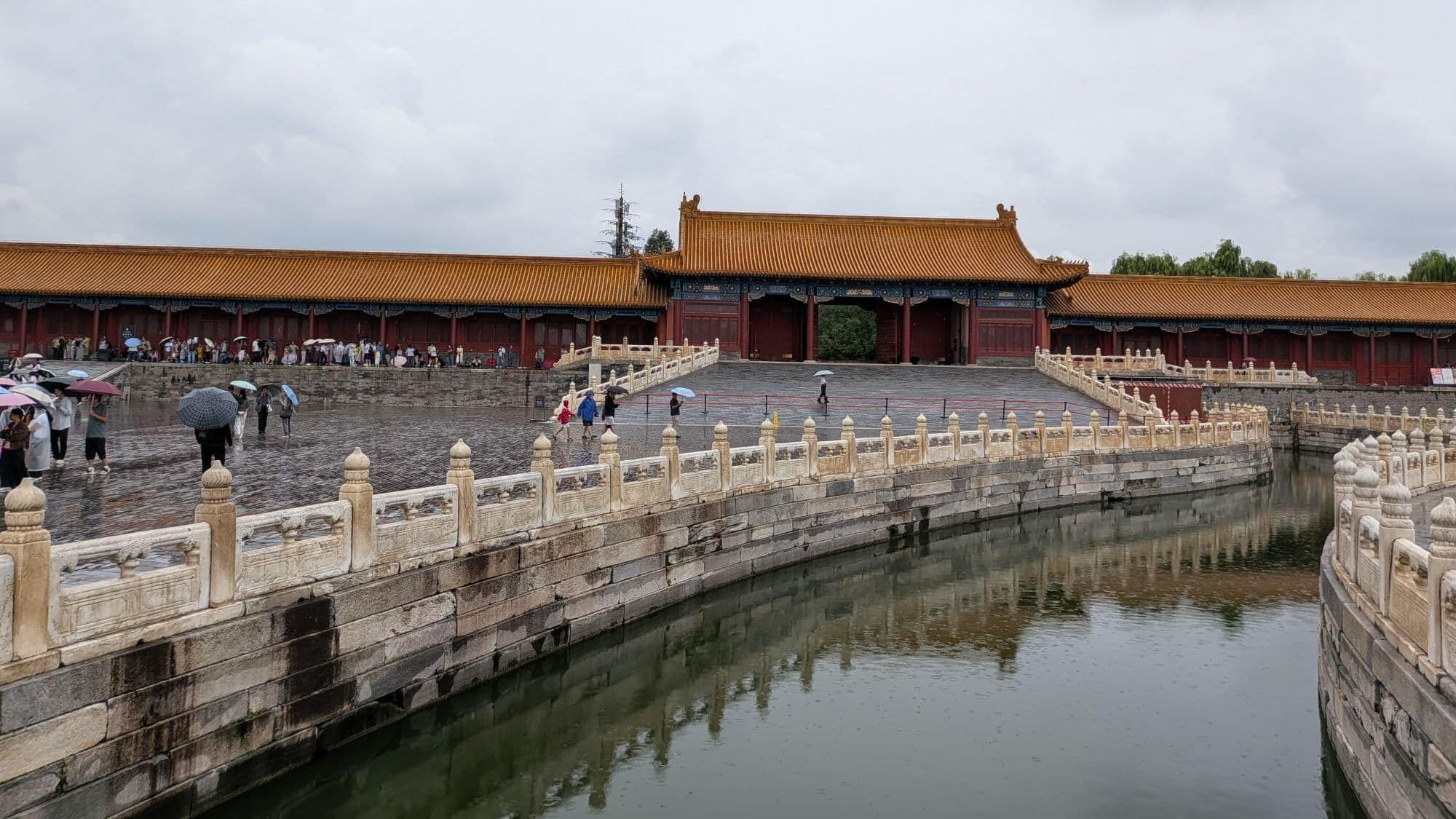
My favourite part was visiting the Forbidden city where the emperor and his harem once dwelt, heavily guarded behind high walls for over 500 years. Nowadays it is a huge museum and it is absolutely gorgeous, with yellow roofs and ivory staircases. It was called the Forbidden city because it is as large as a miniature city surrounded by walls from all sides, but the Summer palace area is 4-times larger still. Noone was allowed inside except for the emperor and his retinue, the army and political guests, as well as any rare scholars that passed the imperial exam, the highest academic honour at the time. However, only the emperor could pass through the largest entry gate and his harem consisted of concubines chosen as teenagers and kept for life, so a single emperor could have 60+ children at a time with different women. Sons were preferred of course, and the concubine would then attain a privileged status. Also, the entire complex was built without a single nail, using interlocking wooden joints, which is why they were very conscious of fire safety and kept water in large jars all around the place. During the Opium wars in the 19th century, the British scraped off all the gold from the fire safety jars and there is something very symbolic about that.
Forbidden city


We also visited some hutongs (narrow historical alleys in a very touristy but still cute part of Beijing that is now a protected historical village area with insane real estate prices per square meter) and the Drum and Bell towers. These twin towers used to announce the time for people to wake up at 8 am and go to bed at 8 pm. Afterwards we were delivered back to our hotel and took advantage of the giant bathtub and caught a few extra hours of sleep before our flight to New Zealand at midnight.
Hutongs with drum & bell towers


If you’ve been following me for a while, you probably know that I’m not a big fan of organised guided tours and prefer to take the time to explore on my own. However, this was actually a perfect first glimpse of Beijing – we got to see some beautiful sights without the added complexity of trying to navigate Chinese public transport, multiple security checks, long entry queues and an entirely different alphabet on little to no sleep. We both enjoyed the tour and I would definitely recommend it if you ever have a longer layover in Beijing.
Before we left, we had a farewell plate of dumplings and a wannabe Beijing duck at the airport after failing to figure out the ice tea vending machine. Until next time, China!


Share your thoughts with me